02 March 2026
New publication shares practical lessons on coalition building
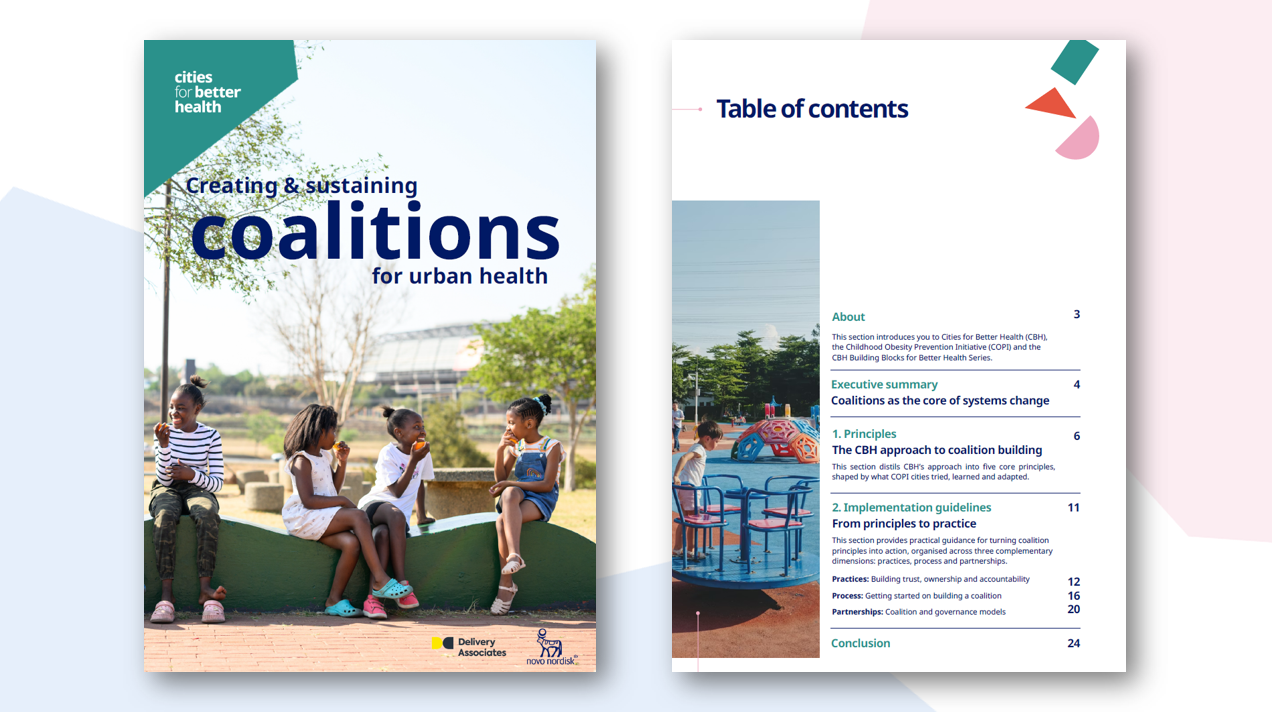
The first publication in Cities for Better Health’s Building Blocks for Better Health series draws on lessons from the Childhood Obesity Prevention Initiative (COPI) to share practical guidance to help cities align partners, strengthen delivery and sustain progress toward healthier urban environments for children.
Urban health challenges require coordinated action
Cities are under pressure to deliver healthier outcomes in environments that are increasingly complex: widening inequities, competing mandates, constrained budgets, and fragmented delivery across institutions and partners. In this context, collaboration is not a nice-to-have; it’s the prerequisite for progress.
To support cities in navigating this complexity, Cities for Better Health launched Building Blocks for Better Health, a series capturing what it takes to deliver sustained urban health change. The first edition focuses on coalition building as the foundation for implementation.
Creating and sustaining coalitions for urban health draws on field learnings from the Cities for Better Health Childhood Obesity Prevention Initiative (COPI), where six cities are building local coalitions to co-design, implement and evaluate interventions that improve access to healthy food and inclusive physical activity for children. The publication was developed in collaboration with Delivery Associates, COPI’s global implementing partner.
Why coalition models matter now
Cities do not struggle to improve urban health because they lack ideas. They struggle because delivering them requires multiple systems and actors to work in sync, and that coordination is hard to sustain without the right operating model.
A school may want to improve meals, but procurement rules sit elsewhere. A parks department may want to create safe play spaces, but maintenance budgets and safety responsibilities are distributed across agencies. Health teams may have data, but not the delivery levers.
Without a shared operating model – clear roles, decision pathways, routines, and accountability – efforts stay siloed, and momentum is hard to sustain through inevitable change and disruption.
COPI’s experience reinforces a hard truth: lasting progress depends on coalitions that connect decision-makers and implementers, align incentives across sectors, and maintain delivery through uncertainties.
A practical approach to coalition building
Coalition building is familiar language in public health. Cities for Better Health takes a tested approach that treats coalitions as an operational engine and not an add-on.
In COPI, coalitions are purpose-built partnerships that shape the work end-to-end, from early situation analysis to intervention delivery and monitoring and evaluation (M&E). The approach is built to balance consistency and local fit: cities work from shared components and evidence-informed guidance but adapt governance and interventions to match local realities.
Local coalition delivery is paired with a cross-city learning network, enabling cities to exchange practical insights, avoid duplication and strengthen implementation over time.
What the publication offers
Creating and sustaining coalitions for urban health outlines five practical principles for designing coalitions that can sustain delivery over time:
- Lay the foundation before you build upward by grounding coalitions in shared benefits, trust, and local identity
- Provide standard components that can be assembled locally to stay aligned and consistent across cities while adapting locally
- Set the pillars that hold governance in place by clarifying decision-making, roles, and identifying champions who can sustain momentum
- Reinforce learning and adaptation into the structure through routine reflection, simple tracking, and cross-city exchange
- Design for sustained operation by selecting long-term partners, positioning external support as catalytic, and embedding work in existing systems
The resource also translates these principles into implementation guidance across practices, processes and partnerships, highlighting common pitfalls and trade-offs cities face as they move from alignment to delivery.
Join the conversation
Moving from alignment to delivery is where coalitions are truly tested. Join the upcoming City Health Talk on 25 March 2026 (14.00-15.00 CET) to hear directly from COPI practitioners working across sectors to align partners, navigate trade-offs, and sustain progress for children’s health.